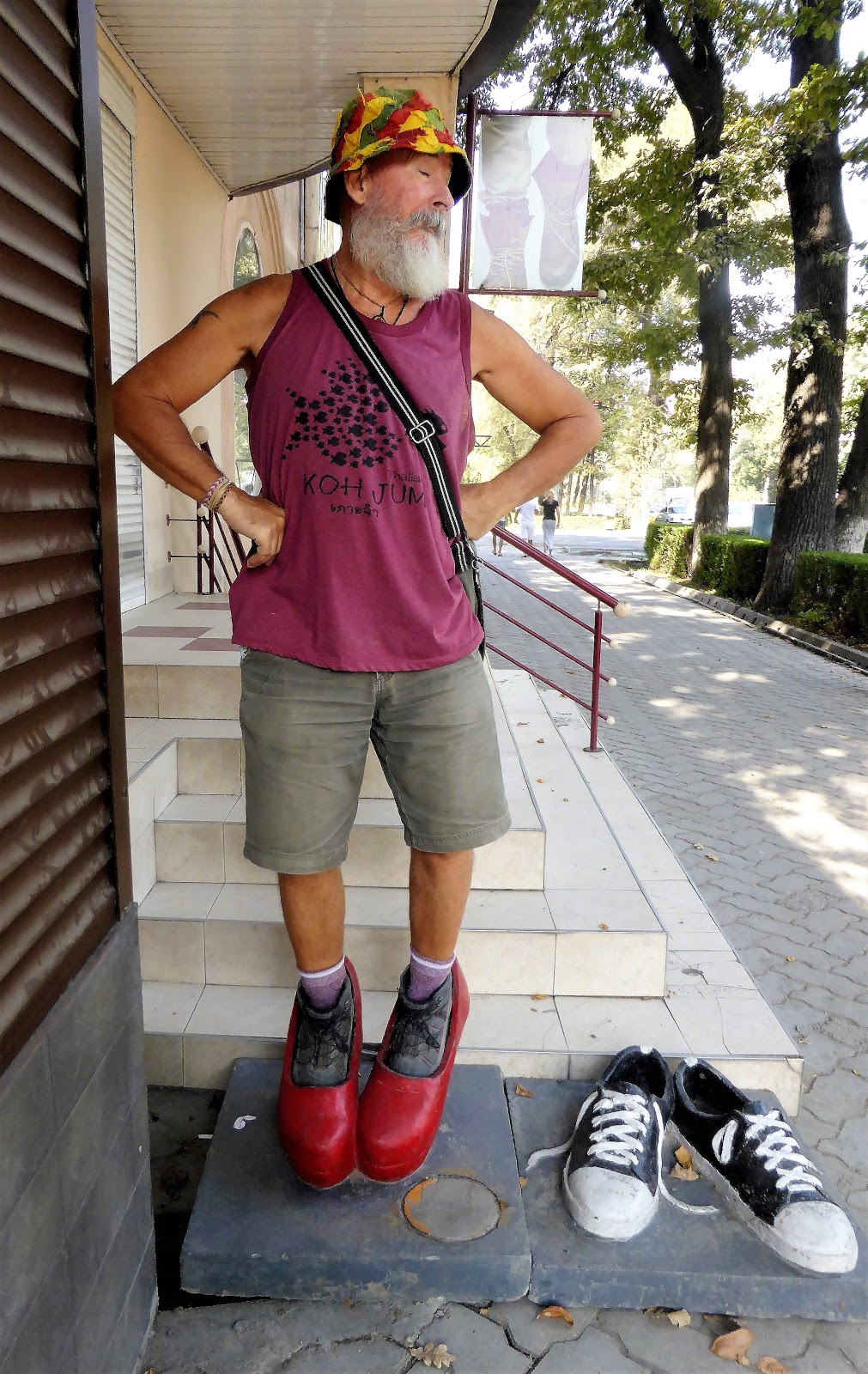
The last time we were in Bishkek was six years ago, and we didn't have particularly fond memories of the place for some reason. This visit, however, we appreciated the sights and sounds more, and loved the vibrant pace and people of the city. Elderly men in tall white Kyrgyz hats mixed with masses of modern university students. Wafts of great smelling food- bread baking and meat sizzling on the BBQ filled the air. Public transport was plentiful, easy and cheap, with fares being a standard 11 or 15 som (£0.10 - £0.13) for the big buses and marshrutkas respectively. The change of climate with drizzly days and cool nights was even pleasant contrast, and the green areas with parks galore was impressive and transformed the city into a relaxed place. Beautiful Bishkek!
Breakfast, samsa and chay, Bishkek
Exactly how many brands of vodka does one need?
Imposing statue, Oak Park, Bishkek
Artwork on exterior of building, Bishkek
Guarding the Kyrgyz flag, Bishkek
Beer with a straw, Bishkek
Osh Bazaar was a firm favourite during this visit, with it's incredible selection of fresh produce, as well as clothes, beauty products and stationary. The section featuring every kind of dried fruit known to man was particularly impressive. Around the outside, we appreciated the second hand clothing shops (we were anticipating some cooler weather coming up), and cheap and delicious local food, specifically shashlik (meat of various kinds on big skewers). We were craving meat, and enjoyed the selection at a local ashkana (simple restaurant).
Every kind of dried fruit, Osh Bazaar, Bishkek
Our favourite shashlik, Osh Bazaar, Bishkek
Taking a break, Osh Bazaar, Bishkek
Garlic in the sun, Osh Bazaar, Bishkek
Several amusements around Bishkek kept us busy for our week or so there. The Zoological Museum was a musty dark place, with most of the mammals, birds and insects on display seemingly having been collected in the 1800s. It wasn't surprising that most exhibits were black with dust, moth eaten and had become somewhat distorted over the years. It was hilarious, and at 50 som (£0.45), we appeared to have got what we paid for. The Minerals Museum marked on the map was actually a working department of the university, and a mad professor wizzed us around a huge dusty old room filled with all sorts of rocks, speaking enthusiastically in Russian, while stunned students looked on, no doubt wondering what we were doing there.
Funny stuffed animals, Zoological Museum, Bishkek
A range of old and dusty relics (and Rich), Zoological Museum, Bishkek
Panfilov Park was a sweet, old fashioned amusement park, and on the day we visited, filled with families with excited children. The mostly tame rides were a throw back to simpler times, with favourites such as riding in tea cups and the Ferris wheel, and side shows featuring such attractions as throwing darts to burst balloons. Kyrgyz love these types of parks, and we have seen them in many towns across the country.
Old fashioned Panfilov Park, Bishkek
Central Asians (or rather the Soviets before them), really know how to do a good park, and they are usually a fantastic place to escape the heat, breath in some fresh air and chill out on a park bench. Bishkek had more than its fair share of quiet green areas, but the enormous and delightful Oak Park in the city's centre was the best. In the drizzly weather the plane trees, acers and of course, oak trees created a cosy feeling. The usual Soviet-era statues were dotted around, along with some funky old art galleries and theatres, and quirky sculptures by local artists.
Spring flowers in Bishkek
Kids playing around the fountain, Bishkek
Quirky sculpture, Oak Park, Bishkek
University wall, Bishkek
On another walk along a river and through a neighbourhood with delightful old Russian-style houses, it was surprising to remember we were still in a capital city!
As lovely as Bishkek's city parks were, we felt the need to get more out into nature, and took a marshrutka to Issyk-Ata, the origin of a natural spring and sanatorium up a beautiful valley a couple of hours from Bishkek. We were very happy we had arrived early for the trip, as the small bus filled up quickly with village people going home after shopping in the city. Some had to stand for the entire trip. We have talked extensively before about the complicated etiquette about seating on Central Asian transport, particularly in Kyrgyzstan.
"It's
a complex and polite system we've seen all over Central Asia, and
amusing for us to watch. Old people get priority with seats, and
sitting near the front. Women of any age take precedence over any man
who is not old. We held fast to our seats comforted in the knowledge
that we covered at least two of the favoured categories! We always
felt sorry for the younger men, who always end up standing, or
sitting in the worst seats."
This flow chart someone at Caravanistan took the time to put together does explain it rather well in a visual form:
It's actually more complicated than this, but not a bad summing up
Although the simple walking track leading from the Soviet-era sanatorium up the valley had been expanded into a rather ugly horse trail, the views were still beautiful, with rather more snow than on our previous summer visit. Along the trail were locals with horses for hire, also selling kumis, fermented mare's milk. This a firm favourite amongst Kyrgyz people, and good to taste once! People picnicked on the grass and in yurts, and splashed around in the newly built hot spring pool at the sanatorium. The bright spring green and the mountain views revived us, and reminded us of what we had coming up on our further trips into Kyrgyzstan.
From the Eastern bus station in Bishkek, we took a surprisingly direct marshrutka to Tokmok- a town halfway between the capital and Issyk-Kol, a lake in the east of Kyrgyzstan.
For years we had wanted to visit Burana Tower, and some affordable accommodation had opened up in nearby Tokmok since our last trip. It was a convenient place to base ourselves for a few days to visit the surrounding attractions. Our guesthouse hostess didn't speak any English, but luckily she was a wizz on Google translate. Many of the questions we asked she didn't know the answers to, but she did some research and always came back to us with the information we needed. It seems she wasn't used to independent travellers on a budget- all her other guests just take taxis everywhere, she told us!
Main roundabout in Tokmok
Ornate bed in guesthouse, Tokmok
Typical apartment building, Tokmok
From Tokmok bus station, we happily discovered many marshrutkas (minibuses) connecting the tiny picturesque villages in the area. A fellow passenger took charge of helping us find the Burana bus, and we set out on a gloriously sunny day for a simply stunning tootle into the countryside. Along the way were meadows with wildflowers and horses, and strawberry pickers in fields with bucket loads of the fruit on the roadside- we were frustrated we couldn't take of advantage of this!
Gorgeous scenery around Tokmok
The remaining minaret that is Burana Tower was apparently part of the 9th century Silk Road city Balasagan. Today, it stands tall in a field, backed by serene views of farms and massive mountains in the near distance. The tower itself has some beautiful brickwork. In the grounds is an intriguing graveyard, perhaps Turkic warriors buried with their faces carved on stones marking their place. The amount of these in one place was curious. There's a lot of speculation about when these date from and what they are exactly, but most of the information is so vague, the true origins seem unknown. We were captivated by the strange atmosphere.
Strange stones, Burana Tower
Grave markers?
Mill stones, near Burana Tower
Turkic gravestones, Burana Tower
Yurt shop, Burana Tower
Stunning backdrop, Burana Tower
A few tour groups came and went, but for the first hour we were mainly alone at the site. Then a bus arrived and musicians, dancers and artists started pouring out and setting up scenes for filming around the grounds. We suspected they might have been shooting a film clip, as the same song was played over and over, but we sat and watched the spectacle for some time. What a treat to hear traditional musicians and see Kyrgyz style dancing in the flesh, especially with such a wonderful backdrop!
Dancers in Kyrgyz costume, Burana Tower
Music and dancing, Burana Tower
Burana Tower
Even the long wait for a marshrutka back to Tokmok couldn't dampen our spirits, we had had such a wonderful day. So inspiring, in fact, we set out again the following day to enjoy another village bus ride and stroll, this time to Kegeti. The scenery of red poppies contrasting with the green strawberry fields and snowy mountains towering over it all were simply gorgeous. A wander out of Kegeti, up a hill to a secluded and abandoned necropolis was pleasant. On the way back we watched some little kids playing a universal game in the street. We have seen variations of the "throw something at a stick and see who can hit it" game all over the world- the most amusing being in Indonesia where they children play it with flip flops.
Kyrgyz necropolis, Kegeti
Love how this guy is simply "Communist"
Walking around Kegeti
Making friends in Kegeti
We had two encounters with drunk men that day. The first was just as we got off the bus, when a car pulled up and a large unsteady man with gold teeth fell out and tried to tell us he was an interpreter for the US embassy. He had been enthusiastically celebrating the end of school term and had gotten slightly carried away. He was very insistent on us leaving with him to continue the drinking, and we had to explain we had only just arrived in Kegeti for a morning stroll. He congratulated Rich on his "simple wife" and then happily got back in his car and was driven off.
New best friends, Kegeti
The second encounter was as we were waiting for the bus to go back to Tokmok, and was far less charming. We could not get rid of the revolting drunk, as he leered over us, nearly falling on Richard and absolutely stinking to high heaven. Richard poked him with a stick and he got the message and wobbled off down the street. We always attract these sorts, without fail.
We arrived in Bishkek's
main bus station in darkness, bleary eyed and feeling rough after a
terrible bus ride from Kazakhstan. After
an hour's sleep amongst the drunks inside the station on hard slated
seats, we set off to find accommodation in the capital. We lucked out
to come across a spic and span, brand new hostel, with our own
bathroom with hot water, breakfast and a lovely, non-English speaking
host. It was located near Osh Bazaar, a slightly dodge part of town,
but the aspect was dramatic with big mountains rising over the city,
and there was plenty of action.
We
had been happy to receive two months visa free on entry into
Kyrgyzstan, and along with free maps available at the hostel and so
much information available on the internet, it was a sharp contrast
to our struggle to find out information in Kazakhstan. However, as we
were soon to learn, the price of such a welcome and ease of travel is many more
tourists in the country!
Osh
Bazaar was another excellent market- they really are a highlight of
Central Asia. People watching and awesome fruit buying were our main
activities- we once again became very excited at the sight of so
many berries! After buying and scoffing kilos of strawberries,
blackberries and raspberries, Rich had to stay quite close to the
toilet the following day! Some interesting things not seen at markets
before on this trip were pellets of chewing tobacco, hundreds of styles of fancy
cakes, strange dried roots and a vast array of spices. We were approached by one of infamous dodgy "policemen" who hang around Osh Bazaar and prey on unsuspecting tourists. Amazingly, he immediately walked away when Rich growled "Go away"!! I guess we were lucky that Rich looks so tough, and that the "policeman" looked a bit weedy!!
The fresh
bread baked near our hostel may have the best bread we had come
across so far in Central Asia- that's with some very
strong competition!! We continued our delicious fresh food picnics at
the hostel.
Berries galore!! Bishkek Osh Bazaar, Kyrgyzstan
Many interesting cakes and sweets, Bishkek Osh Bazaar
Yummo! Bread, Bishkek Osh Bazaar, Kyrgyzstan
Piles of spices, Bishkek Osh Bazaar, Kyrgyzstan
Pellets of chewing tobacco, Bishkek Osh Bazaar, Kyrgyzstan
There were more women in headscarves, more men wearing various head
coverings and many little stalls selling Sufi offerings. Added to
that the sound of mosques calling to prayer, and the city had quite a
different vibe to anywhere we had visited in Uzbekistan or
Kazakhstan. Having said that, there were certainly enough “scarcely
there” numbers to balance things out! The Korean population was a surprise, too. We had heard there were many Koreans living in Kyrgyzstan since they were forced out of their Russian ruled area many generations ago, but until now had not seen Korean businesses and food such as kimchi salads for sale in other places.
We
were to discover that every town and village in Kyrgyzstan has a
least one mosque and they all broadcast prayers five times a day, a
stark contrast to the other Central Asian countries we had visited.
We found the kalpak,
the tall white felt hat for men, a particularly amusing fashion, we
couldn't imagine how it had come about. It didn't seem to have any
practical use- there's no shade against the sun, it can't be pulled over
the ears for warmth- it just sits up there for decoration, it seemed!
Kalpak seller, Bishkek Osh Bazaar, Kyrgyzstan
Kalpak wearer, Bishkek, Kyrgyzstan
Stylish but seemingly useless, Bishkek, Kyrgyzstan
Bishkek
was still hot, although not as stifling as it had been in Kazakhstan.
We had to get out to the hills for a walk!! Issyk-Ata was the best
choice for a day trip from Bishkek. A short marshrutka ride took us
along a picturesque road to a sanatorium quite high in the hills. Brown big-bummed sheep grazed in the fields, and some pretty
cottages amongst the practical concrete ones lined the way. We followed the locals up a tree-lined path that
eventually lead through a gate to a wonderful valley surrounded by
mountain views, shiny horses, wild flowers just coming to an end and
yurts selling kymys
(fermented mare's milk and a national obsession). We followed the
grassy path along the icy blue raging river for miles to a waterfall
until we became tired and returned to the sanatorium for a sticky
beak around the old spa buildings and spring. It felt so good to out and
about walking, and even the hazy views and slight drizzle couldn't
dampen our enthusiasm.
Gorgeous view up the valley, Issyk-Ata, Kyrgyzstan
One of the last wildflowers out, Issyk-Ata, Kyrgyzstan
What a lovely walk, Issyk-Ata, Kyrgyzstan
SO many butterflies here! Issyk-Ata, Kyrgyzstan
What we'd been waiting for! Issyk-Ata, Kyrgyzstan
Finally made it to the waterfall, Issyk-Ata, Kyrgyzstan
Heading back down the valley, Issyk-Ata, Kyrgyzstan
The
sanatorium is a bit of an institution in Russian and former Soviet
countries. Workers could have a break paid for by the state for a
couple of weeks and return to work refreshed. These days, those that
are still standing are more of a recreational/holiday spa combined
with medical treatments, which can be quite bizarre, but often
involve thermal waters and hot springs. The settings are always in
natural beautiful areas, especially mountains, due to the health
benefits of the clean air. Unfortunately, the actual buildings aren't
always in sync with the scenic surrounds, as the Soviets often
favoured brutal, monolithic structures that didn't exactly blend in
with the surroundings. Most that we know of are also extremely decrepit and not maintained very well.Amongst the places we visited in Central Asia,
Issyk-Kol in Kyrgyzstan had the biggest concentration of sanatoriums,
seemingly one in every second town!
Playing with the stream, sanatorium, Issyk-Ata, Kyrgyzstan
Old building in grounds, sanatorium, Issyk-Ata, Kyrgyzstan
Statue of a long forgotten man, sanatorium, Issyk-Ata, Kyrgyzstan
Soviet remainders, sanatorium, Issyk-Ata, Kyrgyzstan
Testing the waters, sanatorium, Issyk-Ata, Kyrgyzstan
Posing for a photo (for someone else!), sanatorium, Issyk-Ata, Kyrgyzstan
Old window in grounds, sanatorium, Issyk-Ata, Kyrgyzstan
Where the mineral water ends up, Bishkek, Kyrgyzstan
A
couple of days were spent exploring the solid city of Bishkek with it's
plain tiled and concrete buildings sitting on huge bare squares, it's wonky
footpaths and decaying government buildings and apartments. It
certainly didn't pretend to be grand or beautiful! The best thing
were the numerous parks with shady paths, large walnut, birch and
oak trees, and wildlife boxes. Every street corner had a lady selling
drinks under an umbrella, which we appreciated in the heat, although
the milky fermented millet variety wasn't to our taste- we stuck to
iced tea and mors,
a fruity berry cordial. The beer stops at bars or cafes were also
welcome..... for US$1 for a large beer, we could afford to do that!
Marshrutkas
and trolley buses helped us when we became tired of walking. The
chivalry we had experienced on public transport so far on this trip
continued, and one friendly driver even gave us a free ride!
Big foot, Bishkek, Kyrgyzstan
Fermented soft drinks, Bishkek, Kyrgyzstan
Soaring statue, Bishkek square, Bishkek, Kyrgyzstan
Flower seller, Bishkek, Kyrgyzstan
The
Kyrgyz people share close ties with the Kazakhs historically,
culturally and linguistically. Actually they are the same people- one
group living on the steppes (arid grasslands), and the other in the
mountains. The area that is now Kyrgyzstan was once home to the
Scythians, then the Karakhanids, who brought Islam to the region. The ancestors of the present
day Kyrgyz people came down from Siberia to escape the wrath of
Genghis Khan between the 10th and the 15th
centuries. Under Tsarist Russia thousands of Russians poured into
Kyrgyzstan and Kazakhstan, and Kyrgyz men were ordered to fight in
World War One. The two countries share the same tragic past under the
Soviets, with many being forced to give up their nomadic lives and
settle in towns, the most “rebellious” being murdered as part of
Stalin's Purges- including all 140 members of the Kyrgyzstan
government.
Before
the lines were drawn up to create the countries of Central Asia,
Kyrgyz people identified mainly as part of a clan, as a Muslim, or as a
nomad.
The
Soviet influence wasn't all bad, however, and some issues such as
women's rights, education, industry, artistic expression and
healthcare were improved.
Probably
as a result of this tumultuous history, Kyrgyz now have quite the
rebellious streak. A Communist government was unanimously voted in
during the time of independence (1991), and at first the government
showed signs of radical reform. But people grew tired of their
corruption and nepotism and after many protests the Tulip Revolution
overthrew the president and more elections were held. Five years
later, again the people were unhappy with government's abuse of
power, and amid much violence and riots the leader was once again
deposed in a revolution.
Really
needing to escape the heat, we travelled east to Issyk-Kol and onto
the mountains.....
Couldn't resist another sneaky and beautiful butterfly pic!
.jpg)
.jpg)
.jpg)
.jpg)
.jpg)
.jpg)
.jpg)
.jpg)
.jpg)
.jpg)
.jpg)
.jpg)
.jpg)
.jpg)
.jpg)
.jpg)
.jpg)
.jpg)
.jpg)

.jpg)
.jpg)
.jpg)
.jpg)
.jpg)
.jpg)
.jpg)
.jpg)
.jpg)
.jpg)
.jpg)
.jpg)
.jpg)
.jpg)
.jpg)
.jpg)
.jpg)
.jpg)
.jpg)
.jpg)
.jpg)
.jpg)
.jpg)
.jpg)
.jpg)