....our previous blog post about quirky Bristol street art here.....
We were slightly
apprehensive about leaving the UK
and embarking on our Portuguese travels. Apart from small trips to see friends
in Europe, we were complete babies
when it came to travel knowledge in the area. We are so at home in Asia- we know how much things cost,
places to avoid, who to trust, where to look for good food etc......all things
we had yet to learn in Portugal. And
organizing our finances in an area where we would have to at least double our
Asian budget would no doubt be a challenge.
After little
research, we took the unusual (for us) decision of prebooking some
accommodation in a couple of places, due to better deals on the internet and
the busy Easter holiday period coming up. It was a bit strange to arrive at our
guesthouse in Faro, the capital of
the Algarve region of Portugal, not knowing what our digs
would be like, and know we had booked in for 3 nights! We discovered a bit of a
bizarre place run by an eccentric fat little man, who huffed and puffed up and
down the stairs, and had raving loud arguments in his dressing gown with his
wife in the front room! But they were friendly enough to us, and our tiled, old
fashioned room was fine for a few nights. A bidet in the room was a first for
us!
 |
| Our Faro room |
 |
| Hotel in Faro, Portugal |
Faro was so completely different from any
place we have been. The old part was wonderful, with small windy cobblestone
streets lined with Moorish style flat roofed houses opening directly onto the
road, mostly white and gleaming in the bright sun. The town squares were filled
with loaded orange trees, and the smell was sweet on the breeze. Apparently, it
was founded by the Moors and destroyed by what was by all accounts an almighty
earthquake which ravaged much of Portugal
in 1755 (more about that later.....).
 |
| Old buildings, Faro, Portugal |
 |
| Glimpse into someone's living room, Faro, Portugal |
 |
| Beautiful doorway, Faro, Portugal |
 |
| Local specialty, Faro, Portugal |
 |
| Street scene, Faro, Portugal |
We very
quickly discovered the amazingly cheap, and good Portuguese wine- our first
bottle costing us 85 Euro cents/AU$1.26. They call the cheap stuff
“green wine”, or young wine, and it’s a bit sparkling, and delicious. It even
came in mini Tetra pack size! Local beers included Sagres and Super Bok. One specialty shop we entered had an amazingly huge selection of Portuguese liquors,
including a bottle of Madeira for 2000 Euro!
 |
| One of Portugal's beer |
 |
| Handy "picnic size" wine |
The couple
of Baroque churches we visited were wildly ornate, impressive and different to
us, but not quite to our tastes. We visited the small old town on Sunday, so saw some of the church services, but
found almost everything else closed and so quiet. It was amazing to see huge storks nesting in equally
enormous nests on anything high enough to be safe on, including telegraph poles
and the tops of church spires. We took a train to another coastal town, Olhao, to wander around more old streets
lined with houses built for the sun. Sal was quite taken with the variation of
tiles on many of the buildings, Rich less so.
 |
| Baroque church, Faro, Portugal |
 |
| Giant stork's nest, Faro, Portugal |
 |
| Chapel with body parts, Olhao, Portugal |
 |
| Lovely tiles, Olhao, Portugal |
 |
| More tiles.....Olhao, Portugal |
 |
| Traditional cafe, Olhao, Portugal |
 |
| Very proud of their most famous son |
Eventually,
it was time to take a train to Silves,
an enjoyable trip with views out to the dry scrubby red soiled landscape, with
oleanders, olives, citrus, agave, eucalyptus and wattle trees. Another booking
awaited, this time in a surprisingly cheap yet swish hotel with a pool, garden
and breakfast included in the price. Our plan was to stay put over the busy
Easter weekend -something we’ve not had to think about before, and relax and
stay in one place until the holidays were finished. It has to be said, staying
at the hotel felt very luxurious and extravagant compared to our normal style
of travel!! We had a room overlooking the castle (as did the garden and pool),
and after a few days getting into the place, we were able to alternate
sightseeing, exploring, walking, eating, sitting by the pool and enjoying our
room at night, nice and cosy with a heater.
 |
| View of Silves castle |
 |
| River through Silves town |
Silves was a small, but lovely and
historically interesting town. It was the Moorish capital at one stage,
although there’s not much left of that era now, apart from the imposing castle,
the winding street design and the badgir-like
ventilation structures on the top of buildings . We had a lovely time wandering
up and down the cobblestones hills, enjoying the architecture in the back
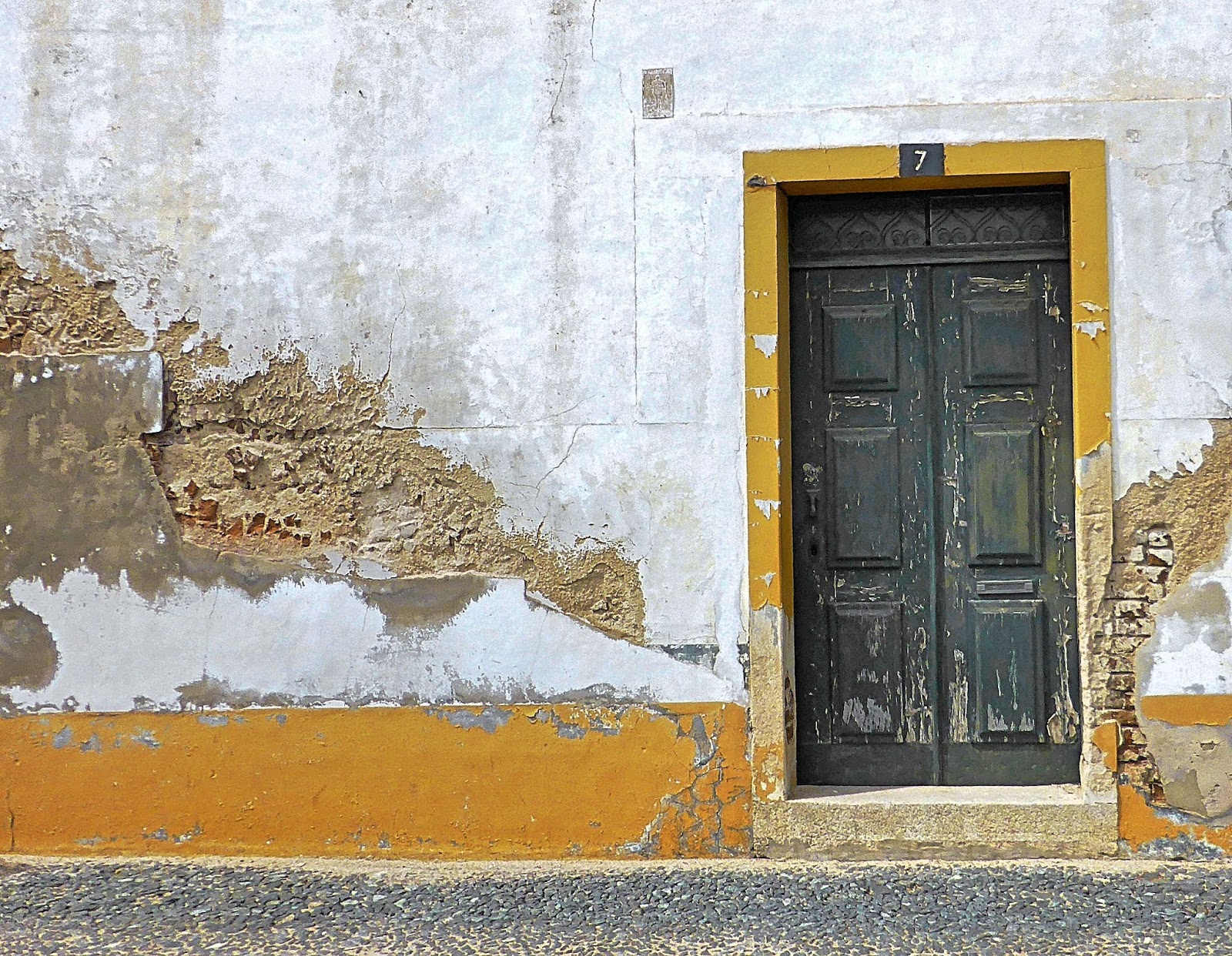
streets, the bright colours and peeling doorways, the warm sun, beautiful blue
skies and looking out at the views from the castle. The cathedral was majestic
but quite disappointing- we were more impressed with the smaller churches we’d
seen in Faro. Most days, the town
was quite busy with package tourists on day trips from the beach areas, not far
to the south. We were surprised how many tourists were around considering it
was so early in the year. The biggest surprise, though, was the stream of motor
homes on the roads and in the huge caravan parks around town. They seemed to be
the equivalent to the “Grey Nomads” in Australia-
Brits and Germans following the sun during the colder months.
 |
| Old sign, Silves, Portugal |
 |
| Wandering, Olhao, Portugal |
 |
| Detail on a Silves church |
 |
| Silves street scene |
 |
| Handsome local, Silves, Portugal |
 |
| Local house with ventilation, Silves, Portugal |
With the
local market and Lidl supermarket a short walk away, most of our meals
consisted of fresh bread, cheeses, salami, sardine pate, raspberry jam,
avocado, tomatoes, strawberries and pears, figs and oranges- mostly local fare.
We splashed out a few times and enjoyed meals in restaurants. The piri piri
chicken was delicious, cooked on a BBQ in the street (and complete with bread,
olives, wine, chips, chocolate mousse and coffee), but unfortunately turned
from piri piri to pooy pooy the next morning! The sardine meal we had was
another matter, revoltingly under cooked at first, and then just plain mushy and nauseating. When we mentioned this to the friendly waiter, he cheerfully said “Oh yes, it’s
a terrible time to eat sardines, they are out of season- you should have
ordered mackerel”! He could have warned us!
 |
| Typical lunch, Silves, Portugal |
 |
| Splash out dinner, Silves, Portugal |
 |
| Bacalhau, dried fish- a national obsession in Portugal |
 |
| Fresh local produce |
 |
| We made the most of these! |
 |
| First time we've seen these since we used to pick them in Oz! |
Two of the best days were spent on walks from the town- one up to a windmill on a distant hill we’d seen from our room window, walking through the fragrant orange and olive orchards and wildflower covered hills just starting to bloom. Cork is another native tree in the Algarve, and we saw the odd one here and there that had been stripped. Shops in town sold products made from the bark, including hats and bags. The second great walk was along a levada (canal), amongst wild lavender and loquat trees, until it suddenly ended in a locked orchard. We loved the glimpse into people’s veggie gardens and sweet backyards, and a detour to a ruin on a hill. The negative part of walking in the countryside was the big guard dogs most houses and farms had. We are not doggie people at the best of times, and the aggressive barking even behind gates had us wary to pass houses sometimes. The dog shit EVERYWHERE was also quite off-putting. Also, randomly, apparently dogs are allowed into church here!
 |
| Hillside windmill, Silves, Portugal |
 |
| Common flower, Silves, Portugal |
 |
| Surrounding countryside, Silves, Portugal |
 |
| Butterfly on wattle tree, Silves, Portugal |
Easter was a quiet time in Silves, with a midnight mass type service in the cathedral (we missed that), and a sweet, but sombre parade through the town on Easter Sunday. Priests held flags and sceptres, and set the slow pace. Most people held flowers, and people leaning out of their balconies added to the festivities by throwing flowers over the procession. We followed for a while, until we lost interest.
 |
| Children in Easter parade, Silves, Portugal |
 |
| Easter parade, Silves, Portugal |
 |
| Aftermath of Easter parade, Silves, Portugal |
After a
month and a half of temperatures below 10 degrees in the UK, it was a welcome change to be warm again and get our shorts out
of mothballs! The weather in the Algarve
was absolutely perfect at the end of March/start of April- around the low 20’s
in the day, and cool at night. We loved being warm, but not hot and sweaty, and
felt energized to be active.
-----------------------------------------------------------------------------------------------------------------------------------------------------------------
The bus to
Evora, an important ancient fortified town further north, was quite convoluted,
involving driving south to change buses to travel north again. Scenically it
was pleasant, with a more agricultural outlook, orchards, including the ubiquitous
olives, grand old quintas (farm
houses), and more vineyards, as this is a major wine producing area.
 |
| Gardens and aqueduct, outside Evora walls |
This was our
first experience with Air B and B, and we were very impressed. We don’t know
what it’s like in other countries, but in Portugal, for about 20 Euros/AU$30
per night, we had great rooms- clean, spacious, sometimes with our own
bathrooms, access to facilities such as kitchens and washing machines, but with
a personal touch. We found it was not only a great money saver (we wouldn’t
have been able to stay in Portugal so long if it wasn’t for these places), but
also almost as good as Couchsurfing when it came to local knowledge and
company.
Our first host
was welcoming and made us feel at ease in our private little studio on the top
floor of her old house. We were even lucky enough a few days later to be around
for a house party, where the place filled up with Portuguese friends and food,
and we were able to drink and taste some special dishes from people’s kitchens.
Our first
stop in Evora was out to find some reasonably priced nosh for our dinner. It
took a while, as inside the city walls, Evora is, in parts, a very touristy
place, but after ending up back nearly where we started, we found the perfect
place. A local’s joint with farmers and trades people, no English, 1.20 Euros/AU$1.75
for a litre of local red, and BBQ chicken and marinated pork dish with rice and a chips for
about 4.50 Euros/AU$6.50 each. We sat there outside on the street enjoying
ourselves immensely- even more so when a local guy took a shine to us and
bought us a whole nother litre of wine!
The whole
walled city of Evora is UNESCO rated, having been the grand residence of the
Portuguese kings in the 15th century. It has roman ruins, white
washed houses, azulejos (Portuguese
style blue and white tiles) everywhere, and despite the hike up hills to get
anywhere, was quite charming.
 |
| Roman ruins, Evora, Portugal |
 |
| Manueline style church, Evora, Portugal |
 |
| Evora, Portugal |
 |
| Water outlet, Evora, Portugal |
 |
| Back street of Evora, Portugal |
 |
| Strange figures on church top, Evora, Portugal |
Perhaps the
most startling sight in the city is the 16th century Chapel of the Bones, a
creepy place built and decorated with the skulls and bones of humans, apparently
to remind the monks that “Life is transitory”. Almost as interesting was the attached bizarre collection of nativity scenes, and Baroque representations of religious figures.
 |
| Inside the Chapel of the Bones, Evora, Portugal |
 |
| Creepy bones, Chapel of the Bones, Evora, Portugal |
 |
| Folk nativity representation, Evora museum |
 |
| Folk nativity representation, Evora museum |
 |
| Baroque representation of Jesus, Evora museum |
One down
side to Evora is the atrocious bus system. Getting around town was confusing to
say the least, and taking a bus further afield impossible in most cases. We
were very disappointed, as many interesting sights lay within a day trip of the
city, but there was no way for us to get to them. We were, however, lucky
enough to hook up with a fellow Air B and B couple from USA, who had a car, and
offered us a lift to see the 7,000 year old cromlech
(megaliths) at Almendres (that’s 2000 years older than Stonehenge!), a 45 minute
drive from town through lovely cork plantations.
 |
| Cromlech, Almendres, Portugal |
 |
| The size of the rocks, Almendres, Portugal |
Walking around
Evora was a blur of churches, azulejos, other
more modern tiles, cafes, stops in the sun, venerable old decorative houses,
and following the intact timeworn walls.
 |
| Cathedral, Evora, Portugal |
 |
| Baroque church, Evora, Portugal |
 |
| Backstreets of Evora, Portugal |
 |
| Moorish style windows, Evora, Portugal |
 |
| Lovely doorway, Evora, Portugal |
 |
| Clouds rolling in, Evora, Portugal |
 |
| Picture of the dead, Evora, Portugal |
 |
| Azulejos, Evora, Portugal |
Most days we
stopped in our favourite restaurant, and hung out there enjoying the craic and
the wine. People were so generous to us, often buying us drinks, and in the
case of one farmer, offering us a place to stay, sampling us some delicious
strawberry wine, and leaving us a pile of his home grown olives!! He was quite
taken with Sal in particular, calling her a “Special human”, and Rich the
perhaps not so complimentary “Ancient boy”!!
We also
enjoyed the coffee shops in the day as break from all the walking. We learnt
that we don’t like the “cafe”-
basically an espresso that is drunk down quickly at a counter, but preferred
the “galao” more like a flat white coffee
that could be savoured outside on the pavement in the sun. We tried a few snacks
too, such as the unique chocolate salami, pastel
de nata (Portuguse custard tarts), bifana
(thin pork sandwich) and Evora’s famous empadas
de frango (mini chicken pies).
 |
| Chocolate salami!!! |
We were ready to leave Evora after a week, and head for the big smoke of Lisbon and beyond..........