.....our Sufi pilgrimage in the Mangistau region, Kazakhstan, here.....
The
Kazakh are, and have always been, nomadic horse-based people since
they were the first to domesticate horses in around 3500 BC. The word Kazakh means adventurer, or free rider, and they dominated the steppes (arid grasslands) of Kazakhstan for hundreds of years. They divided themselves
into “hordes” in the 15th century, which represented
different areas, and to this day this remains an important part of
their heritage. The hordes were the last great nomadic
empire. In the 1700s, one of the hordes needed Russian protection,
and this began the decline into Tsarist rule and the mass immigration
of Russian settlers up until the 19th century. The Kazakhs
were influenced by the Russians, and to this day have the closest
relationship with Russian of all the Central Asian countries. It was
the Bolsheviks that changed Kazakhstan the most, after the Russian
Revolution. Communism was a disaster to the nomads, as part of the
agenda was to turn them into settled farmers. The strong and proud
nomads refused and killed all their herds rather then submit. This
led to huge famines, helped along by Stalin who valued the nomad's
land. To complete the horror, Stalin ordered tens of thousands of deaths of
anyone he thought had thoughts of independence and likely to make
trouble, in what was know as “The Purges”.
Before
the Soviets, Kazakhs assigned themselves according to their clan
mostly, but when the borders were drawn up in 1924, their new nation was invented and they were given a new identity. There were positives
sides to the occupation such as the growth of industry, woman's
rights, education, health care and infrastructure (“What have the
Romans ever done for us?”). In 1991 Kazakhstan became independent following the collapse of the USSR, along with the other Central Asian countries.
 |
| Amongst the ruins in Turkistan, Kazakhstan |
 |
| Where we are in the region |
 |
| Our route through Kazakhstan- the yellow dotty line |
These Kazakh blog posts
are really living up to our blog name!!
The train we took from Aktau
to Aralsk was our first proper long distance Kazakh train (we were
trying to block out all memories of the common train from Beyneu to Aktau!!) It was an old banger, all right, but somehow had an
interesting and shoddy character, and we liked it. As the train began in Aktau, we were able to
board early and make up our beds before the journey- that was after
the pre-requisite photo session with some families in the carriage.
We then watched with horror as the carriage filled up almost entirely
with families with kids/babies, but actually, once we were up on our
little bunks, we were quite separate and undisturbed from what was happening down in
the carriage. As before, we had access to the only tiny window, and
during the heat of the day had the hot and dry desert wind blowing in
our faces, which was slightly better than no breeze at all.
 |
| Sneaky pic from the top bunk, train Aktau to Aralsk |
 |
| Restaurant car, train Aktau to Aralsk |
 |
| Fellow passengers, train Aktau to Aralsk |
 |
| Catching up on study, train Aktau to Aralsk |
The train stations we
saw in Kazakhstan were all quite rough and tatty compared to the spic
and span, well run versions we had experienced in Uzbekistan, and the
Kazakhs were much more relaxed about security, with no showing of
passports or metal detectors at entrances.
The scenery on the
train trip was almost entirely flat steppe (arid grassland), apart
from a small section with sand dunes, and we finally saw our first
two humped camel!
*Note about camels:
We've been confused about which camel is which. Basically,
there are two varieties- Dromedary (one hump) and Bactrian (two
humps), with a few different cross breeds (mostly what we saw). We
were disappointed not to see more Bactrian- apparently they are only
really in Tajikistan.
 |
| Ship of the desert, train Aktau to Aralsk |
 |
| Train Aktau to Aralsk |
At 27 hours, it may
well have been our longest train trip out of Oz. Kazakhstan is an
absolutely huge country (ninth largest in the world- Australia is
sixth), and although we love train travel, we needed to break the
journey.
Arriving in Aralsk at one am, we quickly found a close by hotel, which wasn't perfect, but for
US$7 each, with WIFI and a hot shower and literally out in the middle
of the desert, we couldn't complain. We were surprised to meet a few overland groups in the town, and they were surprised
to see us come from the train!
The Aral Sea was at one
time the fourth largest lake in the world. Now it is greatly
decreased, a victim of Soviet insistence that cotton should be grown
extensively in Uzbekistan and Kazakhstan, and irrigated using the
mismanaged water from the Aral Sea. The coast line from the once port
town of Aralsk receded to 100 kms from the town during the 1940s to
the 1960s. A dam was built in 2005 to try to regain water in the
northern part (Kazakhstan), but the southern part in Uzbekistan was
considered a lost cause. The water is now about 20 kms from Aralsk,
some villages are within walking distance, and fish numbers and
species are once again on the rise. So, although production is tiny
compared with what is was (as is evident from the enormous trawler
hulks in the defunct harbour), there is some hope. We heard there was
a second dam being built, but we weren't able to ask at the local
NGO, as they were closed when we were there. The positive work was
not really apparent in Aralsk itself- a hot, dusty, and desolate
place, with the empty harbour stretching as far as the eye could see.
 |
| Streets of Aralsk, Kazakhstan |
 |
| Aralsk train station toilets |
As we had to wait an
extra day for our next train (the trains in Kazakhstan became booked
up very quickly, and we were lucky to get seats at all), we killed
some time looking at the “attractions” of Aralsk. Of the two
museums, only one was open during our three days there, and even
though there were few English signs, we got the gist of most of it.
We were really interested in the current state of the sea, but most
of what we found out was from the internet. We wandered down to the
defunct harbour, and found some local lads paddling naked in some
tiny pools of water amidst the rubbish and waste. The old factories
and cranes lining what was the shoreline decades ago were a sobering
scene.
 |
| The old harbour, Aralsk, Kazakhstan |
The bazaar was the
heart of Aralsk, full of dusty vehicles, people moving about and
scraggy little parks and squares with statues of unknown heroes. The
smell of grilling shashlik was in the air, and we enjoyed
wandering around the many small stalls and shops, especially liking
the lower prices for produce than we had been paying in Mangistau.
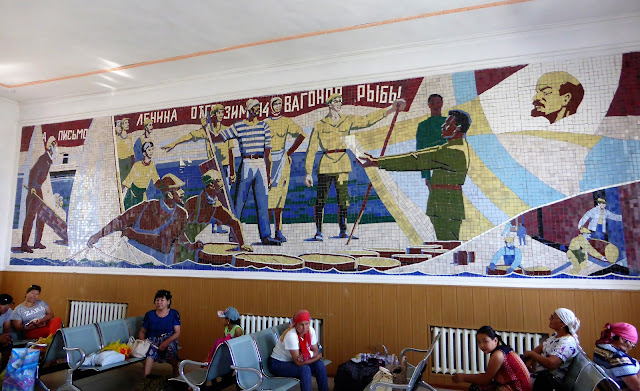 |
| Old mural in the train station showing Aralsk in it's heyday, supplying fish to Russia |
 |
| Shop in bazaar, Aralsk, Kazakhstan |
 |
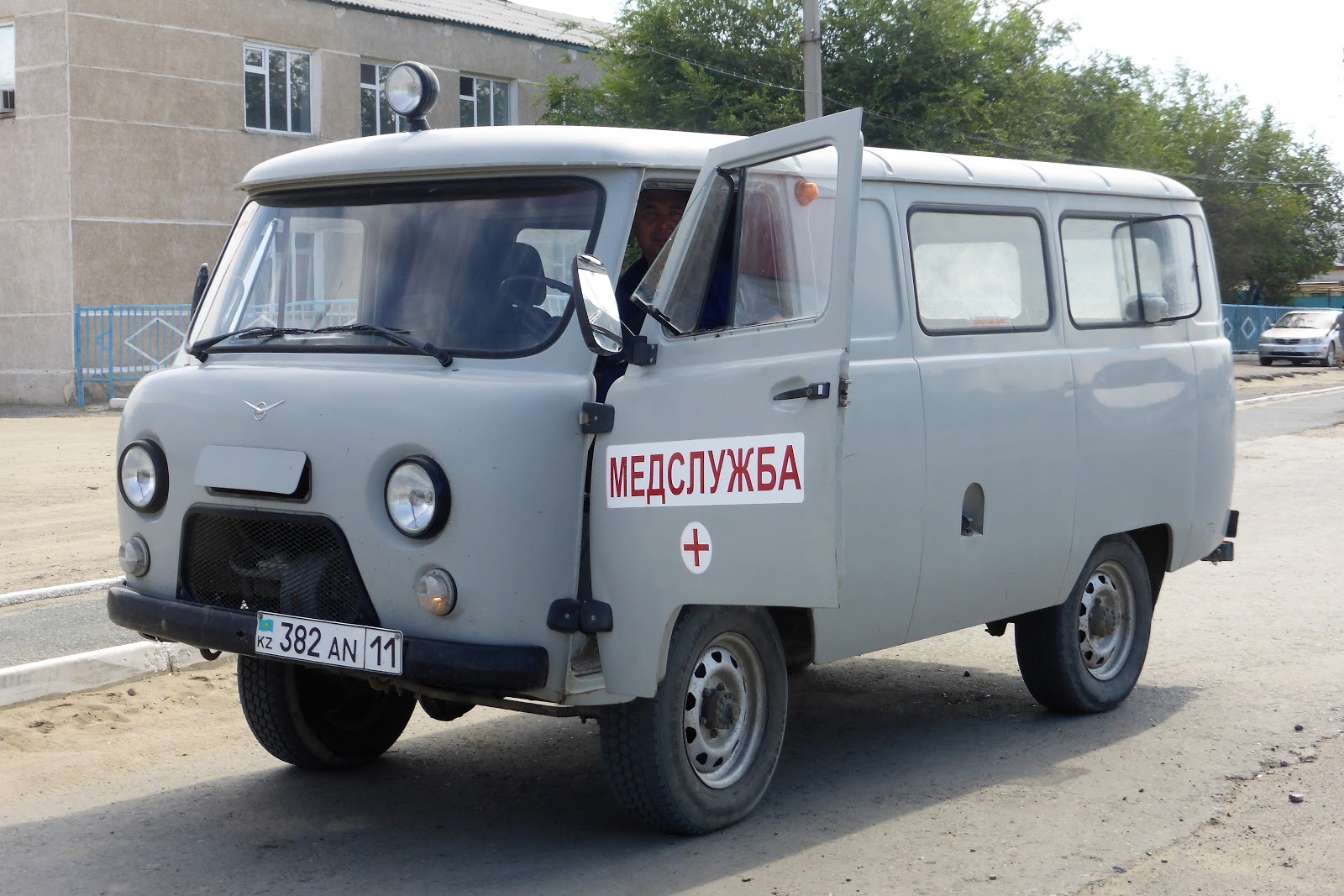
| Old Russian van being used as an ambulance, Aralsk, Kazakhstan |
We came across some of
the town drunks- there was the guy spread eagled unconscious every
day outside the supermarket; the totally wasted man unable to walk
being practically carried away by a rail guard on the train platform;
and the disarming woman who appeared out of the bushes covered in leaves near the
closed museum who tried to follow us. Then there
was the happy old drunk who sat next to Rich on the train platform as
we were leaving, and chuckled away and told stories for more than an
hour, even though it was clear we absolutely no idea what he was
talking about. Actually, it was a common theme in Aralsk, that the
friendly locals would approach us (not usually drunk!) and start
chattering away in Russian, assuming we could understand. We just
smiled and repeated our few measly words (we didn't speak Russian, we
spoke English only, we were from Australia and were here on holiday,
and we liked their town), and they seemed happy!
We were lucky at most
places we stayed in Uzbekistan and Kazakhstan, that they were very
accommodating with our late train departures, and all let us stay on
in the room past check out time.
Our next night train from Aralsk to
Turkistan had a very different feeling to the other trips. It was arriving from Russia,
absolutely packed (mostly with very different looking Russian
people), pretty crappy and cramped, but very fast. As soon as we
boarded, the train took off again, and once we had turfed off the
guys lying on our beds, and gotten the bunks made up with the pretty
flowery sheets (!!), we basically just slept until arriving in Turkistan the next
morning. It was a nice feeling to take it for granted our belongings
were relativity safe on the trains in Central Asia. With our bags
tucked away high up above us, and room to keep our small bags with us
on the bunks, we never felt nervous about theft. Of course, there are
bad people everywhere, and it may sound naïve to say it, but it's
really hard to imagine people here stealing! Certainly none of this
sleeping with one eye open with everything chained together, as we do
in India!
South Kazakhstan is the
most Kazakh part of Kazakhstan, and we felt a distinct change
arriving in Turkistan from the desert areas we had come from. It was
so nice so see green and gardens again! We felt we had finally left
the desert behind, although the dirt and
dust that covered our bodies and bags from the last month and a half
would take a while to wash off!
Turkistan used to be
the name for Central Asia as a whole, but now is limited to one town. It is
where the great Sufi teacher and holy man Kozha Akmed Yasaui lived most of his life and was
buried. In the 1300s, the powerful leader Timur took over
the place and decided to build a far grander mausoleum than was
already there. Having had read that Turkistan was the second most
important pilgrimage place for Sufis in Kazakhstan, we were looking
forward to reliving some of our experiences in Beket-Ata, and
learning more about the mysterious strain of Islam. The LP
really talks up Turkistan, but as we had already seen the best Silk Road Timur architecture (in Uzbekistan), and also the fact that there were no pilgrims
around for the three days we visited, we were left very disappointed. The
complex was small, with just one big building (the mausoleum), and
various smaller, lesser tombs, which were plain and not particularly
interesting, or closed. Perhaps if we had come here first we would
have been more impressed.
 |
| Kozha Akmed Yasaui's mausoleum entrance, Turkistan, Kazakhstan |
 |
| Kozha Akmed Yasaui's mausoleum, Turkistan, Kazakhstan |
 |
| Poser, tiles, Turkistan, Kazakhstan |
Anyway, it was still an appealing little
town, with a cracking market- apparently well known in Kazakhstan for
being particularly cheap and diverse. We certainly appreciated the
prices, as well as the ice cream stalls every few metres! The mix of
buses, shared taxis, exchange booths, food wafting and sellers
calling out gave a bustling and lively feel to the place. The
population was ethnically mixed and dress standards varied greatly
from modest dresses that covered everything to short shorts and
singlets. Scarves and caps were still very much evident. We were
happy to see plenty of friendly faces.
 |
| Scary head, Turkistan bazaar |
 |
| Man fixing shoes old style, Turkistan bazaar |
 |
| Buying bread, Turkistan bazaar |
 |
| Happy boy! Turkistan bazaar |
 |
| Couldn't resist this photo, bazaar, Turkistan |
 |
| Local newspapers on bazaar, Turkistan |
 |
| So many melons everywhere, Turkistan, Kazakhstan |
We also had the experience
of staying in the town's number one nightspot, as our hotel doubled
as a restaurant and disco every night. Although we enjoyed the
spectacle of people dancing and having a great time, we were glad we
had a quiet room on the opposite side of the hotel!
The heat had returned,
and we found it was really wearing us down after so long, and on
the spot we decided to change our plans and leave Kazakhstan a week
early, and escape to the mountainous country of Kyrgyzstan.
Unfortunately, we had left it too late to book a train, so for the
first time on this trip we had to make other arrangements. The first
step was a extremely comfortable large minibus to take us to
Shymkent. Twenty minutes into the trip, we broke down, and Rich and I
feared the worst (that's what travel in India does to you!). The
locals on the bus were calm and accepting, even in the heat, as
though it happens all the time. Forty minutes later a replacement
arrived and we were on our way again. The Kazakh pop was a great
accompaniment to the views of the fields mostly growing melons, and
also small herds of camel, cattle and sheep, and the odd cowboy on a
horse to round them up.
Once we arrived a
Shymkent, we waited several hours and then boarded an overnight big
bus to Bishkek, which reminded us why we always prefer to take the
train! It was quite painful to begin with, as the bus was an old
banger with no AC, and not much leg room, but was made worse by our
very uncharacteristically annoying neighbours in the seats in front.
The kid was an obnoxious brat with no discipline from his mother who
preferred to stick her earphones in and play with her phone. After
the kid spat his chewing gum in Rich's lap, and tried to hit him on
the head with his toy car, Rich firstly appealed to the mother to
control him, and then when that didn't work, whacked him hard on the
hand. That did!! Immigration took place in a blur in the middle of
the night, and we arrived more than half asleep in Bishkek, Kyrgyzstan at four am.
------------------------------------------------------------------------------------------------------------------------
A last note about costs in Kazakhstan:
Costs
are about half what they were last year in Kazakhstan, due to a
devaluation in their currency, the tenge. For us, this made a huge
difference in our budget, and instead of being one of the most
expensive countries to travel in Central Asia, as it was in the past,
it was only a little more than Uzbekistan........and much of that was
because we were in remote areas. Here is a break down of costs in
Kazakhstan for those who would like more details:
(US$1= 325 tenge/AUS$1=
261 tenge)
Accommodation
Beyneu
Hotel, Beyneu 6,000 tenge/AU$22
Aktau
Hostel, Aktau 4,000 tenge/AUS$14
Hotel
Altair, Aralsk 6,000 tenge/AUS$22
Hotel
Edem, Turkistan 7,000 tenge/AUS$26 including buffet breaky
Accommodation was surprisingly cheap in Kazakhstan, and, because of the out of the way places we visited, varying in quality. Mostly it was great value for money, comfortable, and with our own bathrooms and a hot water shower.
 |
| Our spacious "suite" in Aktau, Kazakhstan |
 |
| Crazy wallpaper, hotel room, Aralsk, Kazakhstan |
Transport (per
person)
Urgench
to Beyneu train platzkart 108,000 som 19 hours
Beyneu
to Aktau train common 1,100 tenge 9 hours
Mangyshlak
train station to Aktau bus 80 tenge 30 mins
Aktau
city buses between 50-80 tenge single trip
Aktau
hostel to city taxi 300-400 tenge 20 mins
Hostel
Aktau to Akshukar/Koshkar Ata taxi 400 tenge 20 mins
Akshukar/Koshkar
Ata to hostel bus 90 tenge 20 mins
Hostel
Aktau- Beket Ata group minibus 5,000 tenge each
Mangyshlak
to Aralsk train platzkart 3,313 tenge 27 hours
Aralsk
to Turkistan train platzkart 8495 tenge 11 hours
Hostel
Aktau to Mangyshlak train station, taxi 1000 tenge 30 mins
Turkestan
station to town marshrutka 20 mins 50 tenge
Turkestan to Shymkent big minibus 800 tenge 1 hour 40 mins (+ 40 mins
breakdown)
Shymkent to Bishkek big bus 2500 tenge 8.5 hours
Obviously, we travelled by train most of the time in Kazakhstan. They weren't up to the standard of the Uzbek trains, but still quite comfortable, apart from the extreme heat. They were always clean and tidy (apart from at the end of a long journey), and we were given clean sheets with which to make out beds. Mostly there was no restaurant car, and we took our own food. One end of the carriage would always have a giant samovar, so we were able to make hot drinks. The best thing was the ridiculously cheap prices for long journeys across the huge country.
 |
| Kazakh train toilet (at the beginning of the journey!) |
 |
| Every train has a toilet at one end and a samovar for hot water at the other |
 |
| Great storage system on Kazakh trains |
 |
| Nice and clean and tidy at the start of the journey, Kazakh train |
Food
5
litre water 250-300 tenge
1 litre water 130 tenge
1.5 litre frozen water 140 tenge
Big ice tea 220-300 tenge
Big pomegranate juice 410 tenge
Coffee three-in-one 20 packet 700 tenge
Bread
50-100 tenge
Smetana 310 tenge
Big
chunk cheese with walnuts 360 tenge
Jar
jam 460 tenge
Large
bag biscuits 270 tenge
Big bag pistachios 550 tenge
Whippy
ice cream 80 tenge
Meal
for two at cheap restaurant or fast food 1000- 3200 tenge
Samsa
75-80 tenge
Nectarines
600 tenge per kilo
Apricots 600- 800 tenge per kilo
Massive bunch spring onion 150 tenge
Apples two for 100-240 tenge
Plums 300-350 tenge per kilo
Potatoes 50 tenge per kilo
Tomatoes/capsicum/cucumber 70-170 tenge per kilo
Sadly, the food selection and quality was very similar to Uzbekistan. We avoided eating out due to the unappetising oily and fatty dishes and almost entirely self catered, which we loved. Breads, cheeses and fresh produce were absolutely delicious, and very affordable, even in the remoter areas.
 |
| The offending laghman (doesn't look too bad in the photo!) |
 |
| Typically meaty menu, Kazakhstan |
 |
| More greasy plov- they eat it in Kazakhstan too |
 |
| Shashlik flavoured chips! Kazakhstan |
Although we found the areas of Kazakhstan we visited to be somewhat challenging and a little bit frustrated, we were aware that we had really only touched the tip of the iceberg in terms of traveling in the huge country. We would love to return again and visit the far east and the more Russian north. But for now, the mountains and cool weather of Kyrgyzstan called us.
.jpg)
.jpg)
.jpg)
.jpg)
.jpg)
.jpg)
.jpg)
.jpg)
.jpg)

.jpg)
.jpg)
.jpg)
.jpg)


.jpg)
.jpg)
.jpg)
.jpg)
.jpg)
.jpg)